
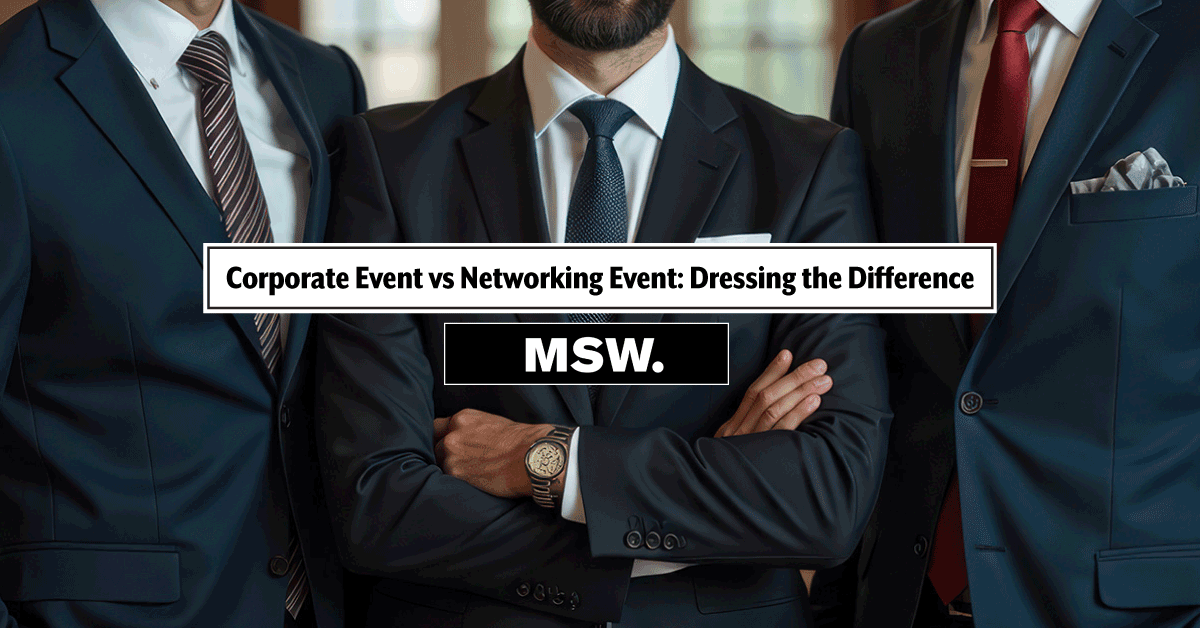
Corporate Event vs Networking Event: How to Dress for Each
Quick Answer: Corporate events (conferences, board meetings, formal launches) generally call for a full suit, while networking events (industry mixers, casual drinks, community meetups) often work best with a blazer and trouser combination. Daytime events lean towards lighter fabrics and colours, while evening functions suit darker, richer tones. When the invitation doesn't specify, err on the side of a touch more formal rather than less.
What Defines a Corporate Event?
A corporate event is any function tied directly to business hierarchy and reputation. Think shareholder meetings, product launches, formal client pitches or industry award nights hosted by your organisation. These settings carry an expectation of polish because you're representing a brand, not just yourself. The safest move here is a well-fitted suit from our business suits collection, paired with a crisp shirt and a tie unless your workplace has explicitly gone tie-optional.

Rembrandt Original Fit Cooper Suit in Charcoal Textured Pure Wool
What Defines a Networking Event?
Networking events sit in a different category altogether. These are industry mixers, association drinks, coworking meetups or conference after-parties, where the goal is conversation and connection rather than formal presentation. The dress code loosens accordingly. A tailored blazer over trousers or chinos, worn without a tie, strikes the right balance between approachable and put-together. Our sports jackets range is built exactly for this middle ground, giving you structure without the stiffness of a full suit.

Suit vs Separates: The Core Rule
If in doubt, ask yourself who's hosting and why. Corporate events are usually organised by your employer or a client and carry an implicit dress code tied to company image, which means a full suit is the safer bet. Networking events are typically hosted by an association or a group of peers, where the vibe is more relaxed and separates read as confident rather than under-dressed. If you're navigating a genuinely ambiguous invite, our smart casual dress code collection is designed for exactly that grey area.

Tie-Optional Scenarios
Ties are the easiest lever to pull when adjusting formality. At a corporate event, a tie signals respect for the occasion and should stay on unless leadership has clearly set a no-tie tone. At a networking function, skipping the tie is almost always the right call, particularly if the event runs after standard business hours. A quality shirt from our men's shirts collection worn open at the collar can carry the outfit just as well as a tie would.

Daytime vs Evening Adjustments
Time of day matters as much as event type. Daytime corporate functions suit lighter greys and navy in breathable fabrics, since the setting is usually well-lit and functional. Evening events, whether corporate or networking, invite darker charcoals, deep navy or black, which read as more considered under evening lighting. For evening networking events specifically, you can afford a slightly sharper edge, such as a textured blazer or a subtle pattern, since the mood is more social than transactional.
The "When in Doubt" Rule of Thumb
If you can't confirm the dress code and genuinely can't decide, dress one notch above what you expect the room to be. It's far easier to remove a tie or unbutton a jacket than to arrive under-dressed with no way to fix it. A well-cut suit can always be dialled down, but separates can't easily be dialled up.
How Men's Suit Warehouse Fits In
Whichever end of the formality spectrum your event sits on, Men's Suit Warehouse has you covered. For corporate settings, our business suits collection offers tailored options built for boardrooms and client-facing occasions. For networking events, our sports jackets range and smart casual pieces let you dress sharp without overdoing it. Finish either look with pieces from our accessories collection to add polish exactly where it's needed.
FAQ
Is a full suit necessary for a networking event?
Not usually. A blazer and trouser combination is generally the better read for networking events, since it signals effort without the formality of a full corporate suit.
What's the safest choice if I'm unsure of the dress code?
Lean slightly more formal than you think you need to. A suit that can be dressed down with an open collar is a safer bet than separates that can't be dressed up.
Can blazers replace suits at corporate events?
Only if the event is explicitly casual or the organisation has confirmed a relaxed dress code. For most corporate functions, a full suit remains the expected standard.
Should I dress differently for an evening networking event versus a daytime one?
Yes. Evening events suit darker colours and slightly bolder textures, while daytime events call for lighter tones and simpler fabrics.
What accessories elevate a corporate outfit?
A well-chosen watch, a leather belt matched to your shoes, and a pocket square are simple additions that lift a corporate look without overcomplicating it.
%20generally%20call%20for%20a%20full%20suit,%20while%20networking%20events%20(industry%20mixers,%20casual%20drinks,%20community%20meetups)%20often%20work%20...)